The Definitive Guide of Customer Acquisition Cost (CAC) and CLV
Today, we’re going to discuss two metrics: Customer Acquisition Cost and Customer Lifetime Value. We’ll talk about what these metrics are, how you can calculate them, and why they’re worth tracking
Introduction to Customer Acquisition Cost
Customer Acquisition Cost (CAC) is the total cost required to convert a potential customer to a paying customer. CAC allows a marketing team to measure the effectiveness of their current marketing strategies and identify any necessary improvements.
As the types of marketing strategies that companies use to approach potential customers become increasingly diversified, the number of metrics that marketing teams need to monitor is also increasing. For any marketing leader that is seeking to actively optimize their revenue flow, CAC is a key metric they must keep in mind.
Why should you be concerned about CAC?
Customer Acquisition Cost allows companies to identify whether or not their marketing strategies are optimized. A high CAC signals to a marketing team that something needs to change. Conversely, a low CAC affirms that the team’s strategies are working and they can continue forward with few changes.
If your business’s CAC is unoptimized, your company is literally bleeding revenue. Here are three benefits that a healthy CAC will provide your company.
1. Improve Marketing Focus
By understanding which strategies provide the greatest returns on investment, marketing teams can focus their efforts on strategies generating the most customer acquisitions while cutting back on poor investments that aren’t generation conversions.
2. Increase Your Profitability
Tracking your CAC and optimizing your strategies accordingly allows you to decrease the amount of money your company invests in getting each customer. Naturally, when you optimize your CAC by investing in strategies with a lower CAC you’re going to be increasing your profit margins.
3. Determine and Optimize Payback Period
Payback period refers to how long it takes for a business to recoup their investments, and ideally, is a metric used alongside CAC. By identifying how much a customer costs to acquire and how much revenue they are generating in a certain time period, a company can calculate their expected cash flow during the payback period. It’s always important for a company to monitor their cash flow, and CAC can help them create forecasts for the future.
How to Calculate Your CAC
For how important CAC is to marketing teams, the formula is very simple:
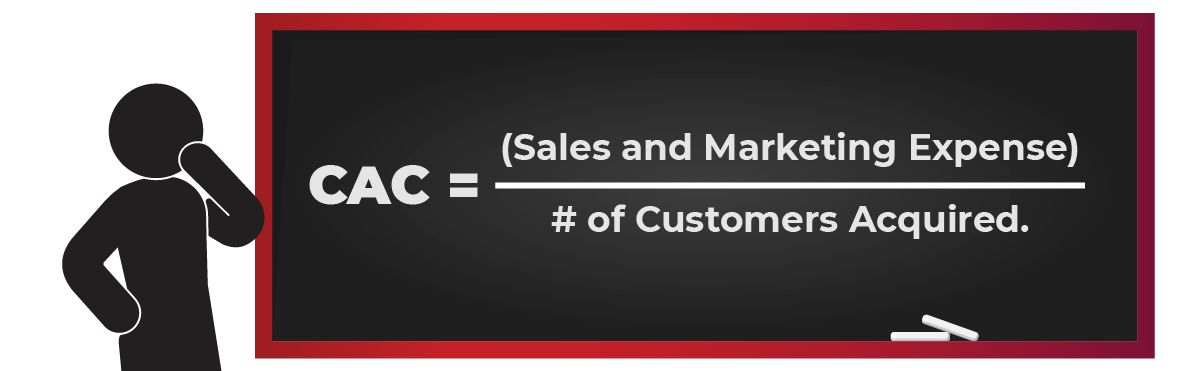
CAC = (Sales and Marketing Expense) / # of Customers Acquired.
Let’s break down the formula.
What qualifies as “sales and marketing expense”?
Sales and marketing expense most commonly refers to any advertising and marketing spending in addition to the salaries of marketers and sales managers, any commissions and bonuses paid, and overhead costs related to sales and marketing. This means that CAC calculation should involve not just the sticker price of the campaign, but all the costs incurred through the duration of the measurement period.
How should I measure Customer Acquisitions?
Customer acquisitions should be measured by the number of customers that are acquired throughout the period of measurement.
CAC Example
Company A spent $3,000 on a social media campaign. The campaign led to 500 new customers. This leaves us with a CAC of $6.
How to Decrease Your CAC
While this list is by no means exhaustive, these are three easy ways you can lower your CAC.
1. Optimize Customer Conversion Rate
Make it easy for visitors to become customers. Whether that means streamlining your payment process, making your sales platform user-friendly, or including call-to-actions in your marketing, there is a negative correlation between conversion rates and CAC.
2. Set Targets (and Adapt)
Your goal has to be more than simply reaching a lower CAC. You need to create specific benchmarks that your marketing team can work towards. You can start by identifying the average CAC within your industry or setting a reasonable customer cost that will increase your profit margins. Make sure these goals are dynamic and are changed to accommodate industry trends and company budgets and profitability.
3. Make Use of Technology
Whether it is social media like Facebook and Twitter or advertisement tools like Google Ads, technology is making it even simpler to maintain low costs even while reaching a larger audience. Make sure that you are properly taking advantage of strong Google Ads campaigns, social media outreaches, and automated email campaigns to convert more leads into customers.
Customer Acquisition is Changing
With new social media platforms constantly being introduced and new technology being developed every day, the customer acquisition scene is changing fast.
Marketing leaders should actively lookout for how their respective market is evolving and adapt their strategies to remain competitive. Especially in a world where effective marketing is becoming increasingly accessible, static strategies are simply not enough to stand out from the competition.
Introduction to Customer Lifetime Value (CLV)
Customer Lifetime Value refers to how much money an individual will bring to the company during their lifetime as a customer. It is essentially the sister metric to CAC and is often used in conjunction to calculate how to optimize a company’s marketing efforts.
The Importance of CLV
CLV is an important metric that allows companies to quantify the value of their marketing efforts. It’s the factor that allows marketing teams to determine the success of their marketing strategies and whether or not changes need to be made. Here are three reasons your company needs to be measuring customer lifetime value.
1. Optimize Marketing Efforts
By calculating the value of their customers, companies are equipped to optimize their marketing efforts. Companies can use CLV as a way to determine which customers generate the most value during their lifetime and set guidelines when creating future marketing campaigns.
2. Increase Profitability
Similar to CAC, having a healthy CLV is a surefire way to increase profitability. Since these customers have already been converted, they’re essentially providing your business with cost-free revenue. By identifying these customers, and determining what segment of the market they represent, your company can create marketing and customer acquisition strategies that target similar customers.
3. Maintain a Healthy Cash Flow
When you know that money is coming in from repeat customers, you are able to create better financial projections and invest in other areas of the company. Whether that means creating new products, expanding into new markets, etc. is entirely based on your company’s goals, and maximizing your CLV is a tried and true way to get there.
How to Calculate CLV
There are two different formulas you can use to calculate CLV: the simple formula and the traditional formula.
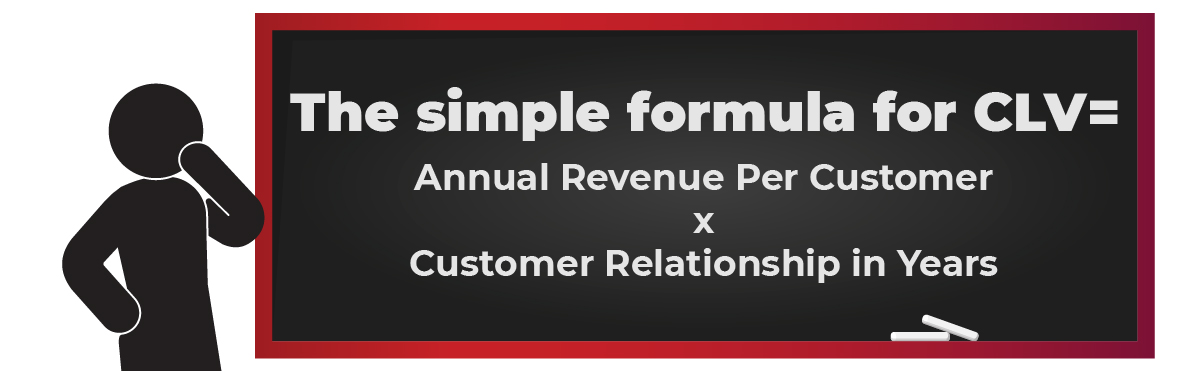
This simplified CLV formula uses average values to calculate the estimated CLV value for customers and is appropriate for quick calculations in industries that have flat annual revenues for customers
The simple formula for CLV is: (Annual Revenue Per Customer) * (Customer Relationship in Years) – Customer Acquisition Cost (CAC).
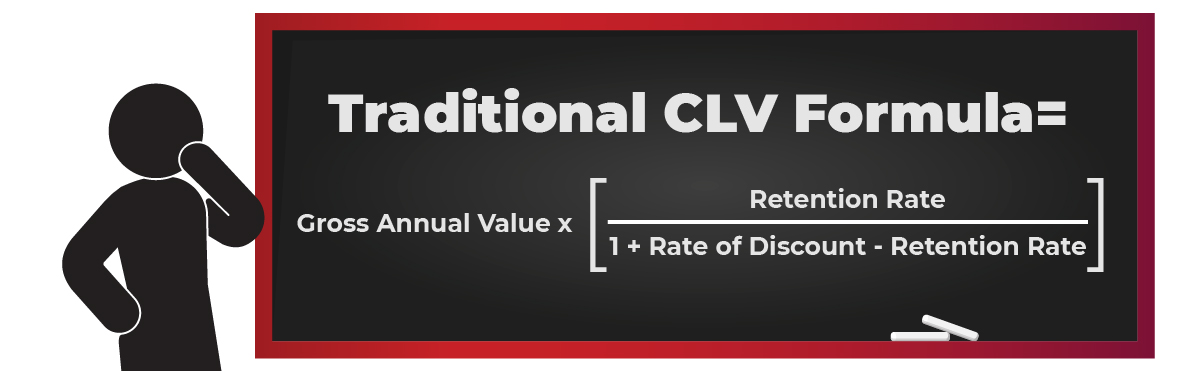
The traditional CLV formula is more comprehensive, and creates yearly estimates based on your retention and discount rates. While it’s more work than the simple formula, it provides a more accurate measurement of your averal CLV.
CLV = (Gross Annual Value) * [ (retention rate) / (1 + rate of discount – retention rate) ]
NOTE: CLV should not be calculated across your entire customer base. Ideally, you should calculate the CLV for each segment of your customer base.
Examples
Simple Formula
Company A is looking to calculate its CLV. Their product costs $8 and they sell 30 units each year. Those customers spend 10 years purchasing from the company Their CLV = 8 * 30 * 10 = 2,400.
Traditional Formula
If their customer retention rate was 20% for the first year and 80% for the following year, the rate of discount is 10%, and customer acquisition cost at $10, we could use the traditional formula to find a better estimate for the CLV.
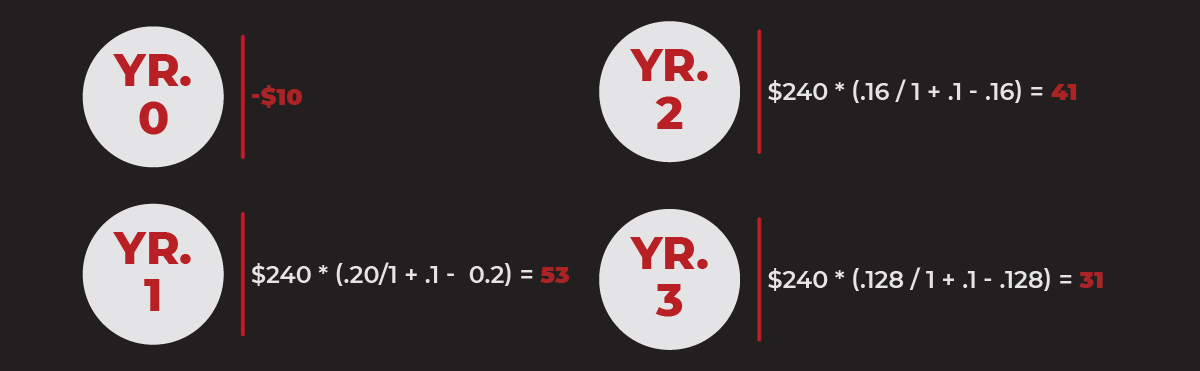
Year 0 = -$10
Year 1 = $240 * (.20/1 + .1 – 0.2) = 53
Year 2 = $240 * (.16 / 1 + .1 – .16) = 41
Year 3 = $240 * (.128 / 1 + .1 – .128) = 31
This would compound until you reach the 10 year lifespan. Then you would add the values to find the estimated lifetime value of the customer.
Although the traditional formula is more complicated, it provides you with a more accurate calculation.
How to Increase CLV
When it comes to increasing CLV, it’s all about keeping a healthy customer relationship. Here are a couple of strategies and how they can help.
1. Improve Your Customer Retention Rates
It’s simple. Customers who make multiple purchases have a higher CLV. Customer retention plays a large role when working to increase your CLV. The best way to keep customers coming back is to set yourself apart from the competition. Consider offering bonuses and incentives, create a positive customer experience, and build authentic relationships and community with your customers. Satisfied customers become high-value customers, so find ways to keep them coming back for more.
2. Create a Positive On-Boarding Experience
It has been proven many times that a positive onboarding experience will incentivize customers to stay longer and continue using your company’s products. In fact, poor onboarding is one of the largest contributors to customer churn. On-boarding can be improved by making the process quick and easy, simplifying the process, or perhaps a buy-in process that tailors to the person’s specific needs and tastes through questionnaires. Also, don’t underestimate the power of post-purchase email flows.
3. Increase Your Prices
While this strategy may not apply in all cases, recall that the discount rate is also a major factor that determines CLV. If applicable, ensure that the pricing of your products or services are not static for long periods of time such that your company is losing money due to inflation. There are many ways to approach this, ranging from keeping prices the same for old users while applying the new price to new users or giving the customer control of determining whether or not they will abide by the new change in price. While this is ultimately up to the discretion of your company in many cases, it is an important aspect of maintaining a healthy CLV.
Reasons to Consider CAC and CLV
The two metrics are closely related to one another. Naturally, you should be looking for an inverse relationship between CAC and CLV with CLV being the higher number between the two.
While CLV is often the more coveted metric (as it is often used by companies to determine the bottom-line of their profits), CAC is equally important since you can’t figure out your profits unless you know your costs. The ideal target CAC to CLV ratio is 1:3.
By taking CAC and CLV into consideration when strategizing, marketing teams will obtain a holistic understanding of their campaign’s performance and can identify new opportunities for optimization.
FINAL THOUGHTS
Whether you’re a business owner, a marketing leader, or just a curious business student, understanding Customer acquisition cost and Customer lifetime value is a critical part of analyzing a business’ activities. Knowing how to evaluate and calculate these values will not only help you make more cost-effective decisions but also help you create sound decisions in the future that will fuel your company’s growth. Connect with us at Fidelitas to learn more!